Junlin Huang; Jiayue Pan; Miao Xie; Chengyi Zhang; Zeqi He; Dan Liu; Zhicheng He; Guohui Li; Mingzhe Li & Xiaoliu Liu
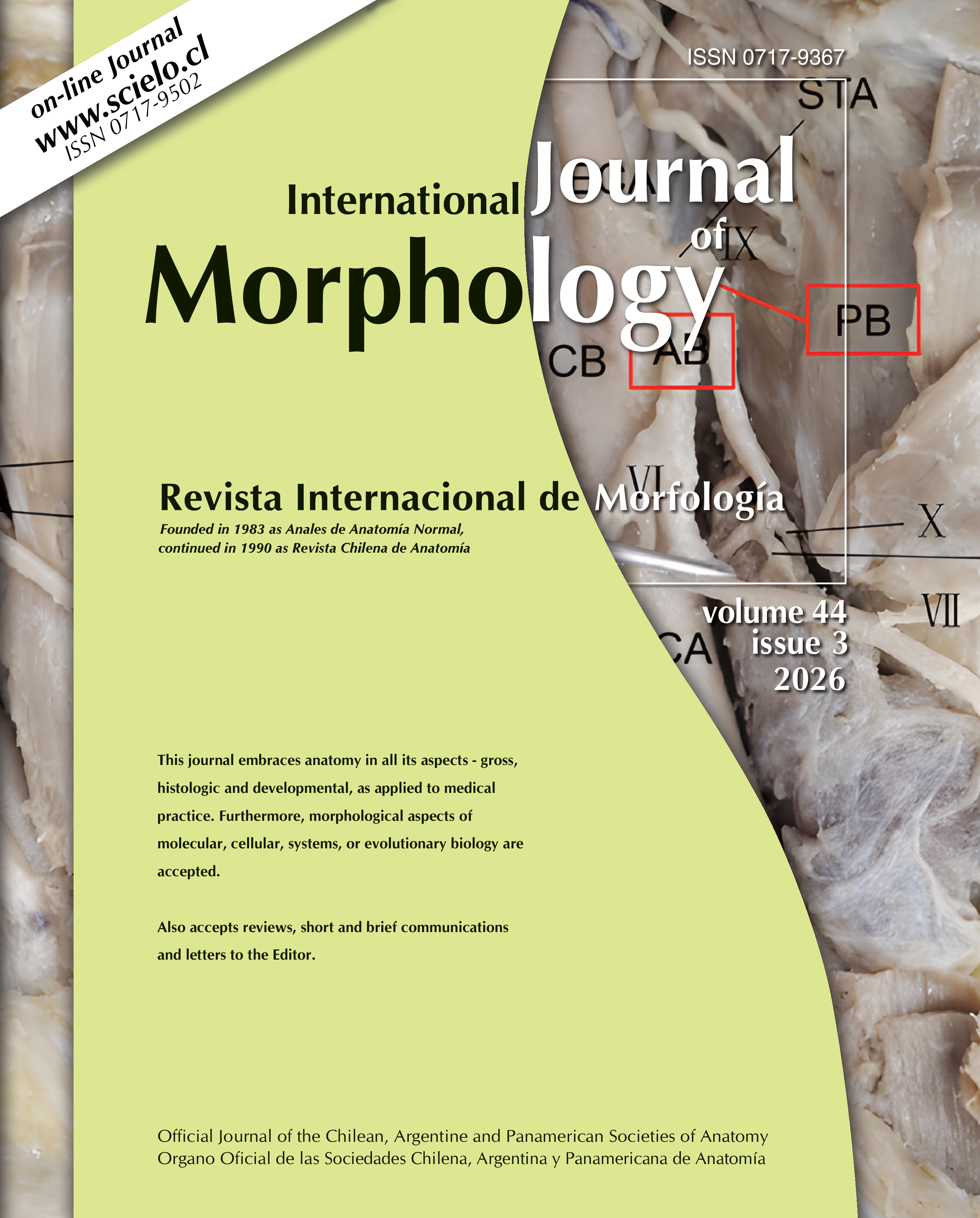
A case of double-branching variant of the right superior thyroid artery. The superior thyroid artery (STA) represents a crucial vascular structure in the cervical region, providing essential blood supply. Clinically, it is imperative to delineate the STA's origin and its branching architecture meticulously to mitigate the risk of hemorrhage and avert severe complications during surgical procedures. In this paper, we report a case of a female with a variant pattern of the STA: the right STA had an abnormal branching pattern, with two (anterior branch and posterior branch) Co-trunked STAs (herein named double branches of the superior thyroid artery) emanating from the anterior wall of the external carotid artery (ECA), of which the anterior branch emanated from a branch of the sternocleidomastoid muscle and a branch of the cricothyroid muscle, which ultimately distributed to the medial anterior lateral lobe of the lateral thyroid gland and the sternothyroid muscle, while the posterior branch emanated from the superior laryngeal artery, which finally branched into anterior glandular branches. The posterior branch gives rise to the superior laryngeal artery, which finally divides into the anterior glandular branch, the posterior glandular branch, and the lateral glandular branch to supply the thyroid. The left STA originates at the level of the common carotid artery (CCA) bifurcation. This article discusses the possible embryological reasons for this variation and its clinical significance, reviews the results of previous studies, and summarizes and analyzes three abnormalities of the STA: origin variation, abnormal branching pattern, and absence.
KEY WORDS: Superior thyroid artery; Branching pattern; Classification system; Anomalous origin; Surgery.
HUANG, J.; PAN, J.; XIE, M.; ZHANG, C.; HE, Z.; LIU, D.; HE, Z.; LI, G.; LI, M. & LIU, X. A case of double-branching variant of the right superior thyroid artery. Int. J. Morphol., 44(3):851-855, 2026.